


















 Eine Trockentoilette benutzen
 Unsere Beziehung zu unseren Exkrementen
 Scheissmanifest
Friedensreich Hundertwasser
Drei Generationen Trockentoiletten Bedienungsanleitung der
 Bio-Streu-Toilette (BST)
Chemische Zusammensetzungdder menschlichen Ausscheidungen
Kompostierungder menschlichen Ausscheidungen
BST im HandelDiese Seiten werden zur Zeit von Freiwilligen ins Deutsche übersetzt, die nicht muttersprachler sind. Unseres Ziel ist es, nützliche Informationen dem deutschsprachigen Publikum zur Verfügung zu stellen.
Um die Qualität dieses Information zu verbessern, suchen wir freiwillige Mitarbeiter für die Korrekturen und gegebenfalls für die komplette Übersetzung anderer Seiten.
Die Wahl der zu übersetzen Seiten überlassen wir immer dem Übersetzer. Vorschäge für eine Mitarbeit bitte an Joseph Országh senden
Um BST selbst zu bauen, klicken Sie hier (Diagramme auf Französisch) oder klicken Sie hier (Diagramme auf Englisch). [Zeichnungen angepasst von Olivier Vienne, Écaussine, Belgien]
Der Text auf dieser Seite erschien im Original auf Englisch unter www.eautarcie.com: 2003
Übersetzung und Anpassung des englischen Textes ins Deutsche durch Ulrich Stauder unter Verwendung von deepL.com. Erste Veröffentlichung dieser Seite auf www.eautarcie.org: 2019-06-01
Letzte Aktualisierung: 2019-06-01



Betriebsanleitung für die Biostreutoilette (BST)

Es ist entschieden: Wir werden eine BST verwenden!
Nachdem sie die Trockentoilettenseiten dieser Website gelesen haben, haben viele die Bedeutung des hierin gewählten Ansatzes verstanden und sich entschieden, eine BST in ihrem Haus zu installieren. Der Schlüssel zum Erfolg beginnt mit einem familiären Konsens über das Prinzip. Bestehen Fragen oder Zweifel, raten wir immer zu einem Besuch bei einer Familie, die eine BST verwendet und korrekt pflegt. Ein tatsächliches Ausprobieren dieser Toilette ist viel mehr wert als die überzeugendsten Reden.
Selbst für diejenigen, die überzeugt sind, ist es ratsamer, es zuerst zu Hause mit einem temporären Aufbau zu testen, bevor man sich auf den Weg macht, um die endgültige BST zu kaufen. Dazu kannst du einen normalen Plastikeimer (gibt es für wenige Euro im Fachhandel) oder einen emaillierten Metalleimer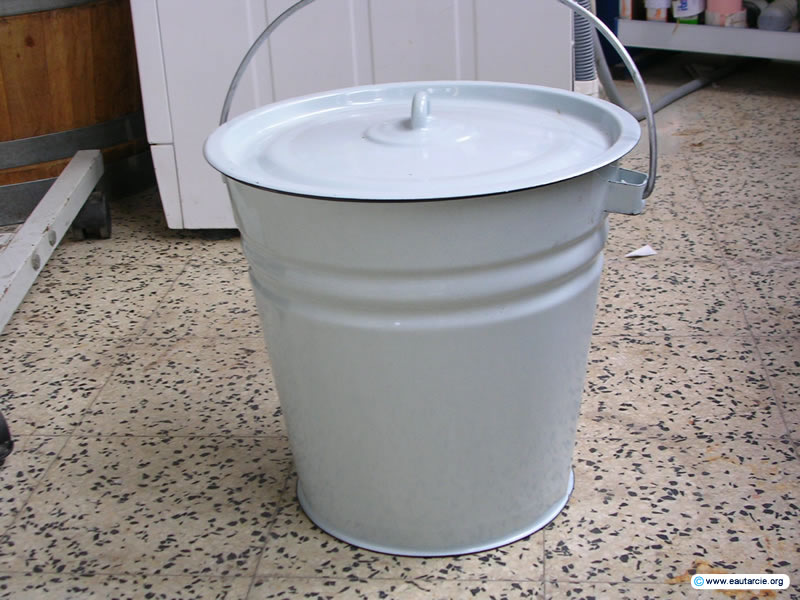 verwenden, den man z.B. in Gebrauchtwarenläden kaufen kannst.
Dieser Behälter wird neben Ihrer Spültoilette platziert. Stellen Sie auch einen Behälter (Korb oder Eimer) bereit, in dem Sie das Einstreumaterial aufbewahren können. Durch diese temporäre Einrichtung kann sich eine Familie mit der Einfachheit und Akzeptanz des Systems vertraut machen. Wenn die Erfahrung schlüssig ist, kommen Sie erst zum nächsten Schritt: dem Kauf oder Bau Ihrer eigenen BST.
Beim Neubau eines Hauses empfehlen wir die Infrastruktur für eine konventionelle Spültoilette bereitzustellen, einschließlich der Wasserzufuhr und der Ablaufleitung (und der Entlüftung, wenn dies nach den örtlichen Vorschriften erforderlich ist). Die BST wird anstelle einer Spültoilette installiert (vielleicht wollen zukünftige Käufer des Hauses vielleicht keine BST benutzen). In diesem Fall haben sie die Möglichkeit, den Raum mit einer Spültoilette nachzurüsten, indem sie einfach die Fliese, die den ungenutzten Ablauf abdeckt, aufbrechen, eine Spültoilette installieren und den Spülkasten an die Wasserzufuhr anschließen - für einen Klempner eine Stunde Arbeit.
Die Familie kann dann ihre Kompostieranlage im Garten errichten. Siehe unser Kapitel über die Kompostierung von menschlicher Ausscheidungen.
Die Einstreu für die Toilette
Das Thema Einstreu für die BST ist Gegenstand vieler Fragen unserer Leser.
Zunächst einmal stellt sich die Frage nach der Menge. Eine wiederkehrende Kritik an der BST lautet: „Wenn die BST jemals zu einem allgemeinen Standard wird, wird es nie genug Pflanzenmaterial geben, um die erforderliche Toilettenstreu zu liefern“. In Wirklichkeit reichen die abgestorbenen Blätter eines einzigen großen Baumes aus, um den Bedarf einer Person für ein ganzes Jahr zu decken. Die Blattproduktion aus einigen hundert Hektar Wald- oder Baumplantagen ist für eine durchschnittliche Stadt ausreichend. Tatsächlich ist jede Zellulosemasse (pflanzlichen Ursprungs) für die Vorbereitung der Streu geeignet. So kann beispielsweise ein Teil unserer Siedlungsabfälle eine beträchtliche Menge an Zellulosestreu liefern: verschmutztes Papier (Servietten, Papierhandtücher, Kosmetiktücher), zerkleinertes Zeitungspapier und vor allem zerkleinerte Kartonagen - auch im bedruckten Zustand. Die Verwendung von verschmutztem Papier ist eine Möglichkeit, das zu recyceln, was sonst verschwendet würde (Papier, das nicht für das Recycling zu Papier geeignet ist); nach der Kompostierung bietet es eine gute Bodenverbesserung.
Die im BST zu verwendende Streu sollte einer sein als die im Garten zur Kompostierung verwendete Streu, um zu vermeiden, dass sich der Toilettenbehälter zu schnell füllt. Für weitere Erklärungen zu den Materialien, die im Garten oder in der Toilette verwendet werden sollen oder nicht, lesen Sie den Abschnitt über die Vorbereitung der Einstreu im Kapitel über die Kompostierung von menschlicher Ausscheidungen.
Dennoch hier eine Zusammenfassung:
Was kann als Einstreu in der Toilette verwendet werden?
- trockene Pflanzenabfälle, Äste und abgestorbene Blätter, gekeultes Unkraut, Heckenschnitt, trockenes Grasschnitt, alle Gartenabfälle usw., idealerweise geschreddert oder gemahlen;
- Holzspäne und Sägemehl, vorzugsweise aus grünem (frisch gesägtem) Holz;
- einige Leute verwenden geschredderten Karton, aber auch geschreddertes Zeitungspapier oder anderen Papiermulch mit einem Aktenvernichter;
- kommerziell verkaufte kompostierbare Tierstreu;
- alle oben genannten Stoffe können miteinander vermischt werden; zerkleinerte Gartenabfälle sind die beste Einstreu.
Was sollte NICHT als Einstreu in der Toilette verwendet werden?
- Erde (Blumenerde, Gartenerde, etc.);
- mineralische Materialien (Sand, mineralische Katzenstreu, etc.);
- Kalk oder Asche;
- Torfmoos;
- Sägemehl und Holzspäne von tropischen Holzarten;
- zu viel kammergetrocknetes Sägemehl, Staubquelle im Haushalt;
- Blätter und Nadeln von Nadelbäumen;
- Kompost.
Bedienungsanleitung
Zu Beginn legen Sie eine Schicht Streu auf den Boden des Eimers, die einige Zentimeter dick ist. Sie werden lernen, die erforderliche Menge mit dem Gebrauch abzuschätzen. Zu viel Einstreu erfordert eine häufigere Entleerung des Eimers. Zu wenig kann zu Geruchsbelästigungen führen.
Decken Sie den Kot nach jedem Gebrauch mit einem Blatt Toilettenpapier und etwas Einstreu ab, den Sie mit einer Wasserflaschenspritze (oder Gartenspritze) befeuchten, wie sie häufig für Innenanlagen verwendet wird. Noch besser: Wenn möglich, urinieren Sie darauf [1] und verteilen Sie den Urin auf der gesamten Oberfläche der Streu, die den Kot bedeckt. Jede Art von Toilettenpapier kann verwendet und im Eimer entsorgt werden. Diese Toilette akzeptiert auch kompostierbare Windeln und Damenbinden, wenn sie auf dem Markt zu finden sind [2].
Das gilt nur für Männer. Wir haben oft stinkende BSTs beobachtet, wenn diese schlecht gehandhabt werden (wobei sich der vorherige Benutzer nicht die Zeit genommen hat, das Streumaterial, das seine Ausscheidungen bedeckt, zu befeuchten). Durch das Wasserlassen auf die Streu verschwindet der Geruch sofort. Diese Praxis wird von Frauen nicht geschätzt, die Tropfen von Urin auf dem Toilettensitz nach dem Gebrauch durch Männer feststellen. Wie können wir eine einfache Geruchskontrolle vereinbaren und gleichzeitig dieses Problem vermeiden? Wenn Sie Männer bitten, im Sitzen zu urinieren wie Frauen, wird die Effizienz dieser Geruchskontrollmaßnahme erheblich beeinträchtigt. Wie Frauen müssen sie die Streu zum Beispiel mit einer Wassersprühflasche befeuchten. Bis BSTs mit integriertem Sprühnebelgerät gibt, bleibt die Debatte offen.... Hinweis für BST-Hersteller!
indeln und Damenbinden sind eine eindeutige Quelle der Verschmutzung. Der Austausch durch waschbare Ersatzstoffe löst das Problem nicht. Bestenfalls können wir verhindern, dass eine umweltschädliche und nicht biologisch abbaubare Substanz in die Umwelt gelangt. Leider würden wir weiterhin Wasser verschmutzen und wertvolle organische Stoffe zerstören, indem wir unsere verschmutzten Baumwollwindeln waschen. Die ideale Lösung ist daher die Herstellung von Windeln mit einem abnehmbaren Saugkissen, das aus Zellstoff besteht, der aus Kartonabfällen gewonnen wird. Dies wäre ein geeigneter Weg, um die Wiederverwendung von nicht recycelbarem Papier zu fördern. Die Verbrennung von Papier- und Pflanzenresten schädigt die Biosphäre.
Warten Sie nicht darauf, dass der Eimer voll ist, da er schwerer zu manipulieren und im Kompostbehälter zu entleeren sein wird. Vermeiden Sie Behälter, die zu groß und schwieriger zu handhaben sind. Kleinere Eimer werden in dieser Hinsicht einfacher sein, müssen jedoch öfter geleert werden.
Nachdem Sie den Eimer in den Kompostbehälter (oder in dem für die Bodenkompostierung vorgesehenen Bereich) geleert haben, spülen, schrubben und entleeren Sie den Eimer, bevor Sie ihn wieder verwenden. Sie benötigen lediglich einen Außenhahn (oder Gartenschlauch) und eine dafür vorgesehene Gemüsebürste (oder Toilettenbürste). Selbst ein Edelstahleimer erfordert alle zwei Wochen eine gründliche Reinigung. Verwenden Sie dazu ein für Bäder geeignetes, gut abbaubares Reinigungsmittel. Wem das Spülen des Eimers nach der Entleerung eine lästige Pflicht ist, oder wer keinen Wasserhahn im Graten hat, kann biologisch abbaubare, kompostierbare Beutel verwenden. Achtung: einige dieser Beutel auf dem Markt können sich im Eimer vorzeitig zersetzen, was zu verheerenden Folgen führen kann. Man sollte sie zuerst testen. Wenn normale Polyethylenbeutel (nicht biologisch abbaubar) verwendet werden, müssen dann manuell aus dem Komposthaufen entfernt werden.
Der Kompostbehälter, der für die Aufnahme von Toilettenabwasser (maximal 1 m² pro Person) bestimmt ist, wird am besten in einer abgelegenen Ecke des Gartens aufgestellt. Sie können dort auch Garten- und Küchenabfälle entsorgen. Um die Ausbreitung von Fliegen zu vermeiden decken Sie frisch abgelagerte Toiletteninhalte immer mit etwas Gartenabfall (Grasschnitt, abgestorbene Blätter, Unkraut oder Stroh) ab.
Entleeren Sie im November eines jeden Jahres den Kompostbehälter und stellen Sie ihn in einem zweiten separaten Komposthaufen auf, der wie ein Dach geneigt ist und den Sie mit ca. 20 cm Stroh bedecken müssen. Nach einem Jahr Reifung ist der entstehende Kompost im Garten einsatzbereit, auch für Nutzpflanzen.
Statt in Behältern/Haufen zu kompostieren, können Sie die Bodenflächenkompostierung (auf Englisch) wählen. Es ist die Lösung für diejenigen, die aus irgendeinem Grund nicht regelmäßig mit einer Heugabel umgehen wollen um den Kompost zu transportieren.
Einen guten Überblick über den Prozess finden Sie in unserem 3-minütigen Video (auf Englisch) auf der BST-Website. Weitere Informationen zur Kompostierung finden Sie im Kapitel über die Kompostierung von menschlicher Ausscheidungen.
Die BST in tropischen Regionen
Wir haben mit BSTs in tropischen Regionen experimentiert (auf Englisch). Bei entsprechender Vorsorge kann die BST auch in den Tropen eingesetzt werden.
Die höheren Temperaturen in diesen Bereichen scheinen die Zeitspanne zu verkürzen, in der die BST bei der Geruchskontrolle richtig funktionieren kann. Bis 25°C gibt es keine Probleme. Darüber hinaus beginnt die Toilette, einen Hauch von Ammoniak abzugeben. Aber der Geruch nimmt nach ein paar Stunden an einem sehr heißen Tag zu. Bei Temperaturen über 30°C für mehr als 24 Stunden (zu Hause) gibt der Inhalt des BST einen deutlichen Geruch ab. Der Geruch ist schlimmer, wenn der Toilettenbehälter (Eimer oder Eimer) aus Kunststoff besteht.
Die Lösung ist einfach: der BST-Behälter muss täglich geleert werden, bei häufigem Gebrauch auch mehrmals täglich. Beim Entleeren des BST-Inhalts auf den Kompost ist darauf zu achten, dass das gesamte Toilettenabfall mit pflanzlichen Materialien abgedeckt wird: Einstreu, Stroh, Grasschnitt, zerkleinerte Pappe. Gleiches gilt für die Kompostierung von Bodenflächen. Wenn die Streu leicht angefeuchtet wird, ist die Geruchskontrolle besser. In tropischen Regionen ist die Kompostierung viel schneller als im gemäßigten Europa. Nach drei bis vier Monaten können Sie Ihren Kompostbehälter bereits entleeren, um die zweite Stufe der Kompostierung zu starten. Die höheren Temperaturen in tropischen Klimazonen machen die Kompostierung von Bodenoberflächen zur idealen Lösung. Es ist wichtig, dem Abwasser, das auf dem Boden verteilt wird, ausreichend Abdeckmaterial hinzuzufügen. Lesen Sie mehr dazu unter Kompostierung von menschlicher Ausscheidungen.
Man sollte Plastikeimer vermeiden und Behälter aus Edelstahl oder emailliertem Stahl bevorzugen.
In feuchten tropischen Wäldern ist es besser, wenn Sie Ihre BST in einem gut belüfteten Außenschuppen aufstellen.
Latrinen sollten sowohl in tropischen als auch in trockenen Regionen Latrinen vermieden werden. Sie riechen schlecht, sind extrem umweltbelastend und Brutstätten von Krankheiten. Es ist überraschend, dass Latrinen immer noch von Fachleuten der Sanitärtechnik sowie von NGOs in Entwicklungsländern empfohlen werden.
Die BST in muslimischen Ländern
Oft fragen unsere nordafrikanischen Korrespondenten:
- Wo kann man in einem Land mit karger Vegetation Streu bekommen?
- Wie benutzt man einen BST ohne Toilettenpapier, während man sich mit Wasser reinigt? (Gleichzeitig weisen dieselben Korrespondenten darauf hin, dass es sich bei ihren Toiletten um türkische Hock-Spültoiletten handelt, die in Klärgruben münden. Sie werden dann mit gravierenden Wasserknappheitsproblemen konfrontiert.)
Die Antwort auf die erste Frage ist einfach: Wo immer Menschen leben können, gibt es genügend Pflanzenmaterial, um den Bedarf an Zellulose-Einstreu zu decken. Wie vorstehend erwähnt, sind alle pflanzlichen Stoffe ausreichend verunreinigt: Pflanzenabfälle aus Gärten und Stadtparks, Pflege von Stadtparks, landwirtschaftliche Abfälle, zerkleinertes Papier und Karton usw. Der daraus gewonnene Humus erhöht die Wasserspeicherkapazität des Bodens und reduziert den Bewässerungsbedarf. In Trocken- und Wüstenregionen kann kompostierter Humandünger die Grundlage für eine effiziente städtische Landwirtschaft im Familienmaßstab sein.
Anscheinend wird in diesen Ländern die Viehzucht auf einer Streuwiese betrieben. Für eine BST braucht man viel weniger Streu als für Tiere.
Zur Beantwortung der zweiten Frage: die Abschaffung von Hocktoiletten würde mindestens 16.000 Liter Wasser pro Person und Jahr einsparen und gleichzeitig die Verschmutzung und die Hygienerisiken durch die Abwasserbehandlung verringern. Wasser, das in Spültoiletten verwendet wird, ist für die Landwirtschaft nicht verfügbar, und dies in Regionen, in den die Nahrungsmittelproduktion durch die Verfügbarkeit von Wasser eingeschränkt sind. In trockenen Klimazonen hat die Verwendung von Spültoiletten auch einen moralisches Apekt.
Das muslimische Waschungsgsritual sollte kein Problem darstellen. So benötigte Joseph Országh nach einem Gesundheitsproblem jedes Mal, wenn er auf die Toilette ging, Zugang zu Wasser. Deshalb hielt er neben dem BST einen feuchten Waschlappen bereit. Nach jedem Gebrauch spülte er ihn unter fließendem Wasser aus. Nach drei bis vier Tagen, in denen er diesen Waschlappen ausschließlich selbst verwendet hatte, kam dieser in die Wäsche.
Spültoilette und BST
Es kommt oft vor, dass einige Menschen es vorziehen, eine Spültoilette im Haus zu behalten, auch wenn der Haushalt auf die BST umgestiegen ist. Das Hauptargument, mit dem diese Entscheidung begründet wird, lautet: „Wir haben nicht das Recht unseren Gästen eine BST aufzuzwingen“.
Die Erfahrung einer großen Anzahl von Haushalten hat gezeigt, dass das Vorhandensein beider Toilettentypen zwangsläufig zur Stilllegung der BST führt. Unterschätzen Sie niemals die potenzielle Rückkehr von eingefahrenen Gewohnheiten.
Dies ist auch eine teurere Option: zusätzlich zum Einbau eines selektiven Grauwasser-Recycling-Systems müssen Sie ein ein separates Vor-Ort-System zur Behandlung des Spültoilettenabwassers bereit stellen, das den Gästen vorbehalten und somit nur geringfügig genutzt wird. Ein solcher Mehraufwand scheint unwirtschaftlich.
Es ist wahrscheinlicher, dass diejenigen, die es nicht wagen, „ihren Gästen ein BST aufzuzwingen“, nicht ganz vom Wert ihres Ansatzes überzeugt sind. Unterbewusst schämen sie sich ein wenig, „anders“ zu sein als alle anderen. Dies ist eine Art Konformismus oder soziale Übereinstimmung. Wenn man jedoch alle Elemente dieses Problems objektiv analysiert, ist die ultimative Schlussfolgerung, dass diejenigen, die sich schämen sollten, diejenigen sind, die mit einer Spültoilette die Umwelt weiterhin schädigen, wenn sie die materielle und technische Möglichkeit haben, eine BST zu benutzen.
Für Familien, die diese Idee fair und einfach übernommen haben, stellt der Einsatz einer BST kein Problem für die Gäste dar. Grundlegende gute Manieren verlangen, dass die Besucher die häusliche Ordnung ihres Gastgebers respektieren. Die Verwendung einer sauberen und gut geführten BST stellt kein Problem dar. Ich habe BST's in luxuriösen Villen gesehen, wo sie von hochkarätigen Gästen ohne den geringsten Kommentar benutzt wurden. Der Ablehnungsgrad eines BST durch Hausgäste ist umgekehrt proportional zu ihrem Bildungsniveau und ihrem Lebensgefühl.
Weiter zu Chemische Zusammensetzung der menschlichen Ausscheidungen.